Future Healthy Countdown

How are Australia’s children and young people faring?
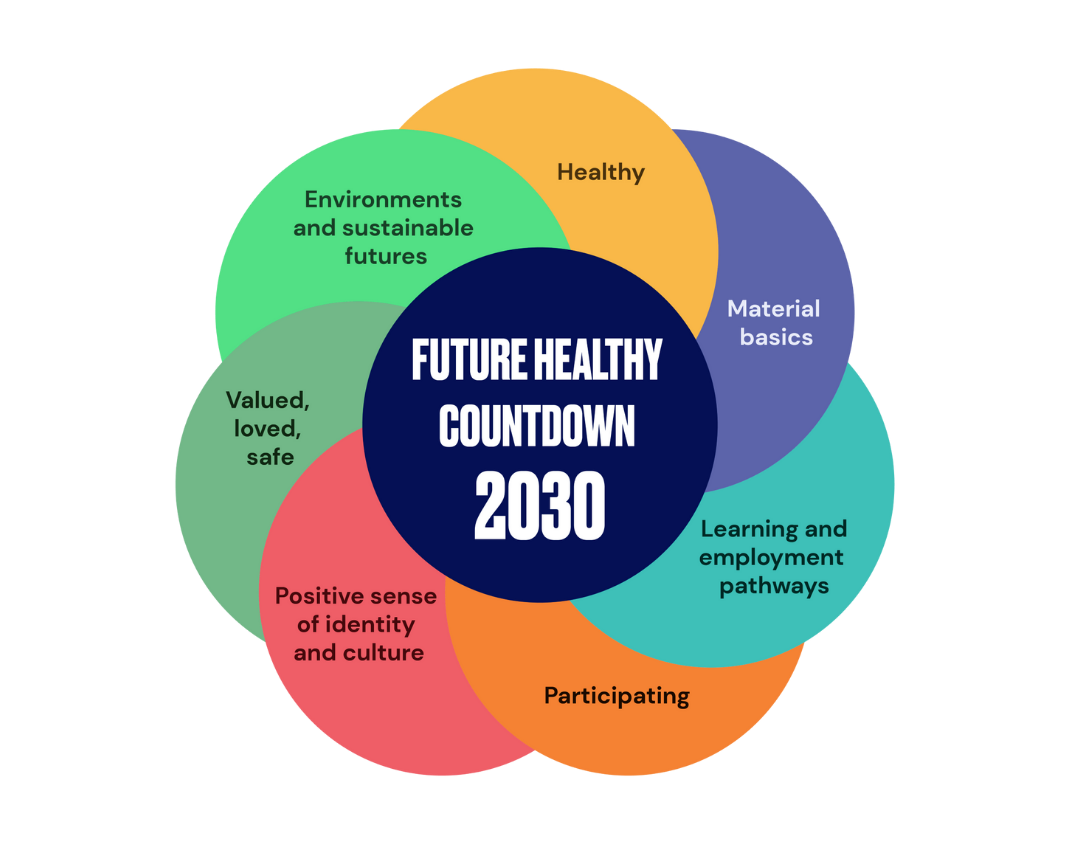
The Future Healthy Countdown 2030 (the Countdown) provides a national accountability initiative to track progress towards improving the health and wellbeing of children and young people and build a healthier society.
 
Each year, the Countdown brings together the best available evidence and policy priorities in one place in an annual supplement to the Medical Journal of Australia.
 
Each supplement dives deep into one of the Countdown’s seven domains, spotlighting evidence-based pathways to better outcomes while also tracking annual progress against key measures and targets for each domain.
 
The Countdown is supported by a set of eight policy actions based on evidence of what works from young people, academics, and policy experts. Each policy action is feasible, immediately implementable, and provides a blueprint for government action to achieve measurable improvements in the health and wellbeing of children and young people by 2030.

"Our local hospital is over an hour away. Our local clinic only... had a doctor in the past few years. We went years without a doctor. We went years without aged care services. We only got them back in the past few years. And people were having to travel over 2 hours just to receive support and basic care." (Ava, Under 18)
HEALTHY
"Try to improve the bullying problem and people discriminating LGBT and disabled people" (Anonymous)
VALUED, LOVED AND SAFE
"I've had to work so hard to be able to allow you to be able to go on that excursion at school. Like you better enjoy it sort of thing. Like that mentality of more focusing, less focus on the money stress rather like don't put that on the child. That is an adult responsibility, not child responsibility." (GZ, Over 18)
MATERIAL BASICS
"The syllabus doesn't cover enough and there's often zero to no guidance for schools or teachers on what really needs to be covered. So then the information that's given to students is always like quite varied across like states and schools. (Serena, Under 18)The syllabus doesn't cover enough and there's often zero to no guidance for schools or teachers on what really needs to be covered. So then the information that's given to students is always like quite varied across like states and schools." (Serena, Under 18)
LEARNING AND EMPLOYMENT PATHWAYS
"Young people would design services that are easier to access, non-judgemental, culturally safe, and shaped by lived experience, with young people having a real say in decisions." (Anonymous)
PARTICIPATING
"I think for a lot of us, we end up moving away for opportunities. So we're away from family, we're away from culture. So having access to that, whether that be through your family, like... keeping on contact or visiting country, but it can be really hard and you can feel really disconnected." (Sian, Over 18)
POSITIVE SENSE OF IDENTITY AND CULTURE
"Children and young people are critical to all climate conversations. A sustainable future isn't a nice-to-have. It's the only future we've got." (Angelica, Over 18)
Environments and Sustainable Futures